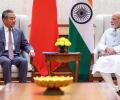
China's Foreign Minister Wang Yi expressed China's anticipation for Prime Minister Narendra Modi's visit to the Shanghai Cooperation Organisation (SCO) summit, emphasizing the importance of strong India-China relations and mutual cooperation.
He said that the two nations will have issues in the foreseeable future. However, there are ways of addressing those issues and what happened in 2020 was not the way to address those issues.

The memoranda of understanding were signed during a day-long 2nd India-China Strategic Economic Dialogue in New Delhi.
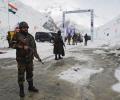
With Beijing remaining intransigent on the withdrawal of additional troops deployed by the People's Liberation Army (PLA) since the deadly border clash in 2020 in eastern Ladakh, India's bilateral ties with China remained frozen in 2023 with no forward movement on the horizon despite several rounds of diplomatic and military talks.
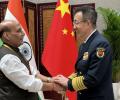
China has called Tibet-related issues a 'thorn' in India-China bilateral relations and a 'burden' for New Delhi, ahead of External Affairs Minister S Jaishankar's visit to China.

In their first structured bilateral talks in nearly five years, Prime Minister Narendra Modi and Chinese President Xi Jinping Wednesday agreed that India and China can have a 'peaceful and stable' relationship by displaying maturity and mutual respect and endorsed the pact on the resolution of the dragging eastern Ladakh border row.
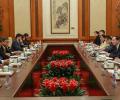
In the talks, China emphasised that the two sides should proceed from the fundamental interests of China, India and adhere to the strategic height and long-term perspective of China-India relations, the readout said.
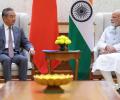
'New Delhi is not naive about its foreign policy choices.'
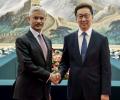
India and China should build on 'good progress' in normalising the bilateral ties to address border-related issues including de-escalation, and it is essential to avoid 'restrictive trade measures and roadblocks', External Affairs Minister S Jaishankar said on Monday during talks with his Chinese counterpart Wang Yi.

India and China on Monday held a fresh round of military talks with a focus on disengagement of troops in the remaining friction points in eastern Ladakh and ease overall tensions in the region.

Immediately on its return from the July 4th holiday recess, an angry Republican dominated US House of Representatives has lashed out against the Obama administration for providing India and several other nations waivers from sanctions for cutting its oil imports from Iran, and threatened to take legislative action to rebut the administration's reprieve to these nations, by passing tough new sanctions.

He said China has accrued significant capacities for force mobilisation, application, and sustenance of military operations and maintained the long-pending boundary issue can not be divorced from bilateral relations between the two Asian giants.

'We should carefully handle issues concerning each other's core interests. We should properly manage and control problems that cannot be solved for the time being'
This is the first time such a bilateral dialogue focusing on Central Asia where the two countries have long and historical ties was held, reflecting deepening diplomatic engagement between the two neighbours even as they try to sort out friction resulting from recent reported incursions by Chinese troops along the Ladakh border
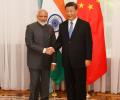
'The fact that Modi and Xi exuded confidence to accelerate the negotiations for a border settlement alone underscores that the Russia-India-China triangle has become very dynamic,' notes Ambassador M K Bhadrakumar.
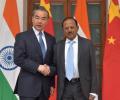
The two sides have already held 21 rounds of talks under the framework of SR dialogue which was set up to find an early solution to the border dispute.

Chinese Foreign Minister Qin Gang reiterated that the situation at the India-China border is generally stable and both sides should consolidate the present achievements and strictly abide by the relevant agreements while pushing for further cooling and easing of the conditions for sustainable peace and tranquillity at the frontier.
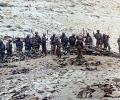
In the 15-year dataset, the researchers noted an average of 7.8 incursions per year even though the Indian government's estimates are much higher.

'Disengagement is merely the first step in a lengthy process of arriving at a new normal along the LAC in Eastern Ladakh and the entire land boundary.' 'The Indian government should insist on the restoration of the status quo ante in Eastern Ladakh.'

China on Thursday said the meeting between Prime Minister Narendra Modi and Chinese President Xi Jinping in Russia's Kazan on Wednesday carries a "great significance" as they reached an "important common understandings" to improve the bilateral ties.
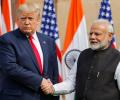
The China threat continues to resonate in the strategic partnership between India and the USA, points out Rup Narayan Das.

Disengagement from the LAC will remain a chimera because China has given enough indications that the PLA will not move back any more. China has even deployed drones to monitor and deny any patrolling by Indian troops even in the buffer zones which are all in Indian Territory, explains Lieutenant General Prakash Katoch (retd).

'Given China's past behaviour and their territorial claims, should we be sceptical regarding China's willingness to adhere to these agreements fully? The answer is yes.' 'As Ronald Reagan famously said in the context of the SALT talks, 'Trust, but verify!' India should also do the same.' 'This has already begun with foot patrolling, drones, satellite imagery and so on. India's military deployment did mirror China's and will continue to do so in the future.'

'The border deal offers a hedge for India against Trump's unpredictability when it comes to his approach to competition with China.'

Montek welcomes investment in infrastructure; deals worth over $5 billion signed at the 2nd India-China Strategic Economic Dialogue.

The talks will focus on 'delimitation of the border, boundary management and a host of bilateral and international issues'.

On India's entry into the NSG, he said, "We have said many times this is a multilateral issue."

"We are waiting for our good friend Modi and best regards to him," the Russian media quoted Putin as saying in the meeting with Doval.

'Russia remains in a unique position since it has special strategic relations with both India and China and these relationships are independent in nature'

Russian President Vladimir Putin on Tuesday thanked Prime Minister Narendra Modi for trying to help find a peaceful solution to the Ukraine crisis.
'India's relationship with China has been and will continue to be complex, delicate and sensitive,' says Rup Narayan Das.
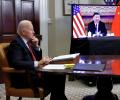
Washington is signalling to Delhi that it can rely on American support in any great game vis-a-vis China. Delhi shouldn't fall into the trap, argues Ambassador M K Bhadrakumar.

He, however, asserted that China was against terror outfits and any form of terrorism.
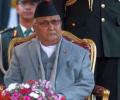
He claimed that India built a Kali temple, created 'an artificial Kali river' and 'encroached the Nepalese territory through deploying the Army' at Kalapani. The river defines the border between the two countries.
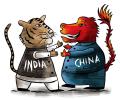
India and China achieved a major milestone this year when their bilateral trade crossed the landmark figure of $100 billion but it did not generate any fanfare in both capitals as the two Asian giants are going through a "particularly bad patch" in their relations due to a set of actions by Beijing in violation of agreements that led to the military standoff in eastern Ladakh. Starting with a modest $1.83 billion in 2001, the bilateral trade crossed $100 billion-mark in the first 11 months this year, a significant milestone for which the two countries carried out campaigns to boost trade and build it as a major stakeholder to improve the relations between two nations, whose ties otherwise remained frosty over the festering boundary dispute and strategic rivalry. According to last month's data from China's General Administration of Customs (GAC), the India-China bilateral trade totalled $114.263 billion, up 46.4 per cent year-on-year from January to November 2021.
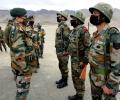
The seventh round of military talks between India and China held on Monday was "positive and constructive", and both sides agreed to earnestly implement the understanding reached by their leaders to not turn differences into disputes, a joint statement by the two armies said on Tuesday.

The external affairs ministry said the talks were 'positive'.

Sources said the Indian delegation was warmly greeted by senior officials of the Chinese Army before the talks began.

The talks came a day after the two armies began a limited disengagement in a few areas in Galwan Valley and Hot Spring in a demonstration of their intent to end the row peacefully.
